
Why is Alentejo getting poorer? — Opinion by Carlos A. Cupeto in Público
In an opinion piece published in Público on 14 January 2026, Carlos A. Cupeto, a geologist and professor at the University of Évora, reflects on poverty in Alentejo and the role of mineral resources in regional development. Below is our English translation of the full article.
1/15/2026
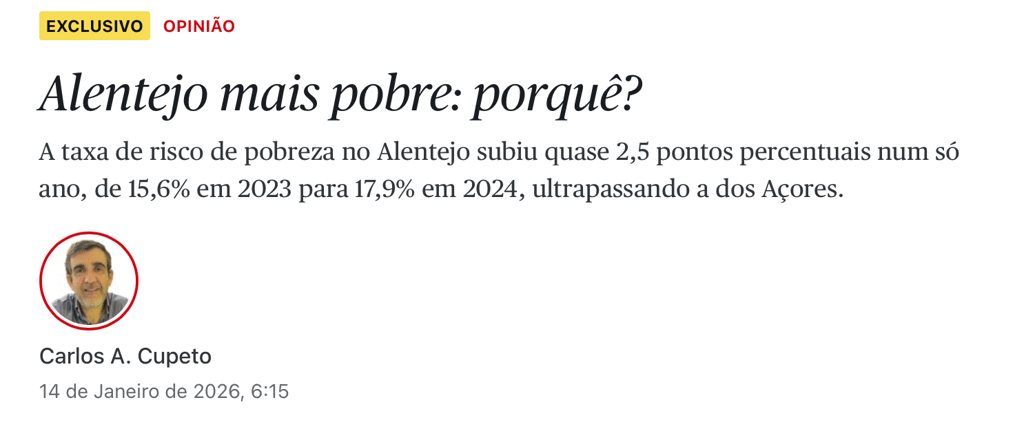
Why is Alentejo getting poorer?
Carlos A. Cupeto
Geologist and professor at the University of Évora
Originally published in Público on 14 January 2026
English translation prepared for the Mina da Borralha website from the Portuguese original. This is not an official translation by Público or the author.
Read the original article in Público
The figures are clear and troubling. According to the study Portugal desigual, by the Francisco Manuel dos Santos Foundation, updated using the latest Survey on Income and Living Conditions from Statistics Portugal (INE), released on 11 December, Alentejo became the poorest region in the country in 2024. The at-risk-of-poverty rate rose by almost 2.5 percentage points in a single year, from 15.6% in 2023 to 17.9% in 2024, overtaking the Azores.
The paradox is clear: nationally, poverty reached its lowest level since 1994. There are no easy answers, nor is there a single explanation. Structural, historical, natural and political causes have accumulated over time.
First of all, geography matters. Minho receives three times as much rain as Alentejo, and its soils are more fertile. Where there are cows in Minho, there are sheep and goats in Alentejo. Overall, the North has more favourable natural resources, and this is reflected in the wealth it generates. But reducing the explanation to geography would be convenient and inadequate.
Alentejo possesses strategic resources that cannot be overlooked, particularly mineral and geological resources, which are essential to life and to the enormous challenges of our time, notably the energy transition and social well-being. Yet these resources remain widely stigmatised and blocked by a mixture of hypocrisy and ideological manipulation that prevents their responsible use. Examples abound: gold in Escoural, very close to Évora, or the promising Lagoa Salgada mine in Grândola. Unlike a solar farm or a forestry plantation, these resources are where they are; they cannot be relocated. Ignoring them is a bet on poverty.
Alentejo has allowed itself to decline, becoming increasingly empty, losing human capital and letting countless opportunities pass it by. This region has a deeply rooted culture of fatalism that inevitably leads it towards poverty. A culture of protest has taken root, cultivated by unmistakable ideological interests, which invariably attributes responsibility to outside forces: usually the central government in Lisbon or capitalism, supposedly lurking around every corner, not forgetting the heavy legacy of “49 years”, which continues to be invoked and kept alive. Like it or not, only those who do not wish to see it, or cannot, fail to recognise that ideology continues to exercise control and determine decisions. In a country dominated by the state, and in an Alentejo with an extremely weak business sector, this absurdity is supposedly a lifeline: the state steps in everywhere, ineffectively, while failing to do what it should. And so the cycle of poverty and protest continues.
Yet a region such as Alentejo is often left with only the state, itself increasingly depleted and incapable. Compared with its counterparts in other regions, the Alentejo Regional Coordination and Development Commission is an excellent example of the growing inability to support wealth creation locally; the results speak for themselves. The small arenas of local and regional public administration serve only to sustain an impoverished local political scene.
What, then, is Alentejo lacking? First and foremost, it needs a change in collective attitude: less fatalism and a greater sense of responsibility for the region. It needs the political courage to acknowledge that these resources exist and should be used intelligently, with rigorous environmental standards and benefits for local communities. It needs the ability to turn public investment into economic development rooted in the region. It needs better-informed choices, a discussion free from dogma about the roles of the state, private enterprise and the community, and an understanding of who creates wealth, who captures it, and who regulates it and how.
Do we want to keep managing poverty, or finally begin creating the conditions to overcome it? Do we want an Alentejo preserved as a museum and dependent on others, or a region that is vibrant, productive and socially just? The answers will come neither from Lisbon nor from Brussels: they must be found in Alentejo